Cover-up Tattoo in Vienna: What's Really Possible
A tattoo that no longer feels right doesn't have to stay that way. A cover-up can turn it into something new that you feel good about again. It isn't an eraser, though: here's what's possible, which tattoos are hard to cover, when laser treatment helps and what to bring to your consultation.
The basic rule: darker and larger
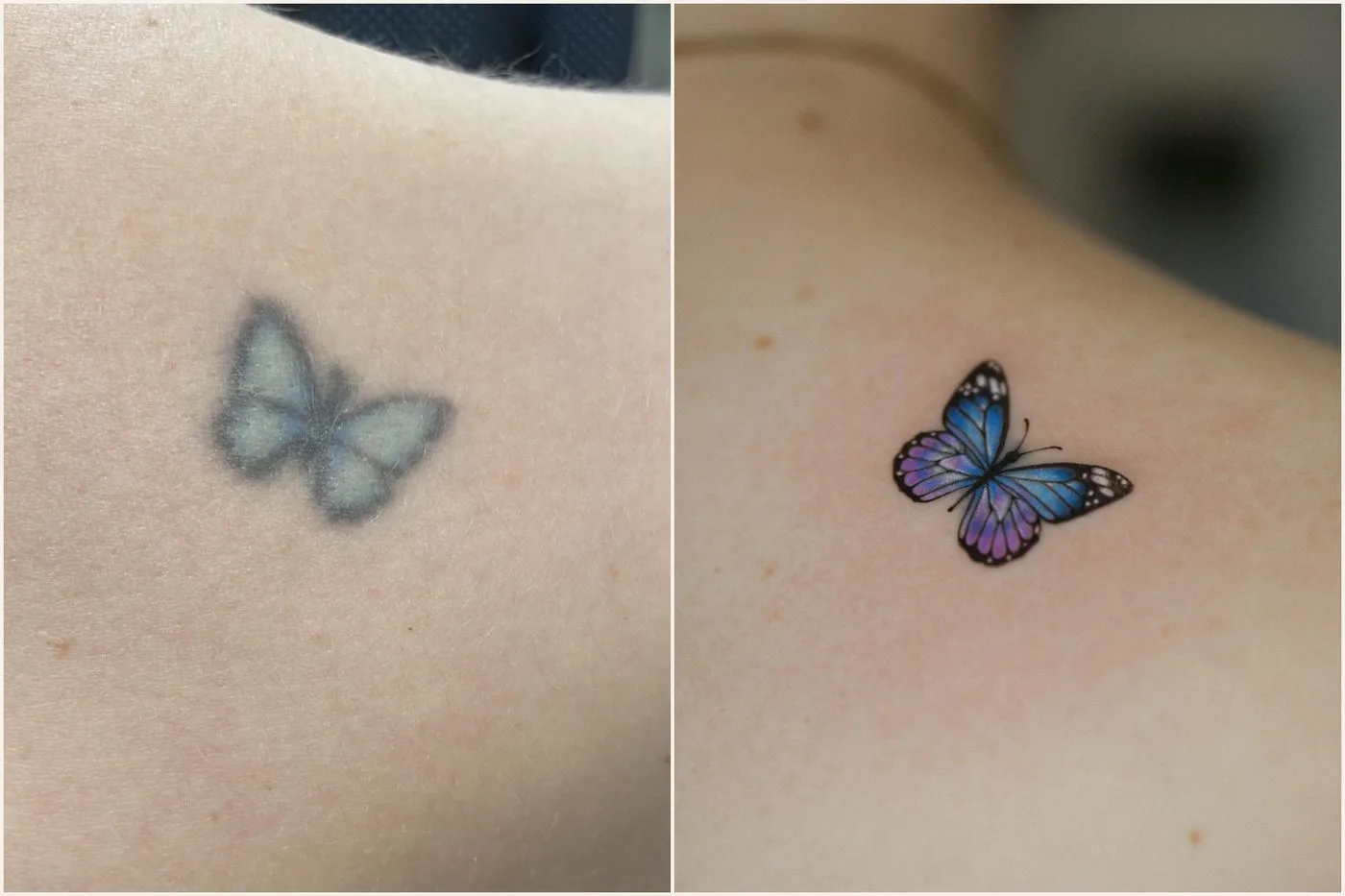
Tattoo ink isn't opaque. New ink doesn't simply sit on top of the old tattoo; the existing pigment affects how the new colors and shapes look. That leads to the most important rule: a cover-up generally needs to be darker and larger than the tattoo underneath.
Darker, because light colors can't hide dark pigment. A white highlight over a black line won't make the line disappear.
Larger, because a new design needs room to absorb the existing tattoo and draw the eye away from it. A cover-up on exactly the same area is therefore often difficult. If you want a small, delicate design instead of a large, dark one, lightening the old tattoo with a laser first is often necessary.
What makes a tattoo hard to cover?
What matters is less the subject than the amount and distribution of pigment. Large, heavily saturated black areas are difficult, as are very thick lines and tattoos with a lot of dark blue or green. Scarred skin can also limit the options considerably.
Older, faded pieces, fine lines without large filled areas, designs with plenty of open skin and tattoos with soft contrast are comparatively easy to work with. Placement matters too: plenty of space around the old tattoo allows more freedom than a design already surrounded by other tattoos.
When does laser treatment help before a cover-up?
A common misconception is that you have to choose between laser removal and a cover-up. In practice, combining both often makes sense. It doesn't have to mean complete removal: partially lightening the old tattoo can be enough to give the new design more freedom.
How many sessions are needed can't be said in general. It depends on the pigments, the depth of the tattoo, your skin and how it responds. The skin needs time between treatments and has to be fully healed after the last one before it can be tattooed again. A cover-up with laser preparation can therefore take several months.
You can learn more about the process on our page about tattoo removal in Vienna.
Which designs work well for cover-ups?
Good cover-ups work with filled areas, movement and contrast rather than delicate single lines. Organic designs work especially well because their irregular shapes adapt to what's underneath. Floral compositions, leaves, feathers, water or smoke can absorb old outlines without a straight line giving away where the old design was. Realism with strong dark values, blackwork and bold ornamental work can cover a lot as well.
It gets difficult when the new design itself depends on lightness and very fine lines. A delicate fine line design over a dark old tattoo usually won't work without preparation, because the fine lines disappear into the existing pigment.
Whether your cover-up is done in black and gray or in color also depends on what's underneath. Color over color is possible, but it takes a precise understanding of how old and new pigments interact.
Cover-ups over scars and blowouts
Scar tissue takes ink differently and often less evenly than healthy skin. If there's scarring under the old tattoo, that affects the options. Tattooing over scars is generally possible, but the situation should be assessed first. Our article on tattoos over scars explains more.
A blowout is a different case: ink went too deep and shows up as a blue-gray shadow next to the line. A new design may be able to absorb that area, but it has to be taken into account from the start.
What should you bring to your consultation?
The better your artist knows the starting point, the more accurately they can tell what's possible. A sharp daylight photo without flash or filters helps, along with the approximate age of the tattoo and whether it has been lasered or reworked. If the new design needs to be larger, the distance to neighboring tattoos matters too.
It helps just as much if you can say what exactly bothers you about the old tattoo. Sometimes it's the whole design, sometimes only part of it, and sometimes a rework is enough instead of a full cover-up. Bring your idea, but also some openness: with a cover-up, the old tattoo has a say in what's possible.
How much does a cover-up cost?
A cover-up is usually more involved than a new tattoo of the same size. The design has to be built around an existing shape, the area tends to be larger, and dark or complex sections take more time. Laser preparation adds separate appointments and costs. Our article How Much Does a Tattoo Cost? explains the general factors.
What expectations are realistic?
A good cover-up isn't a tattoo where you can't detect anything anymore. It's a tattoo where nobody looks for the old design. Depending on the starting point, traces of the old pigment can show up on close inspection, in certain light or after a few years. Good planning can often reduce this a lot, but not always rule it out completely.
If truly nothing of the old tattoo should remain visible, complete laser removal followed by a new tattoo is the way to go. It takes longer and costs more, but it gives you full design freedom again. And the best time to avoid a cover-up is before the first tattoo: our article on bad tattoos explains what to look for.
Cover-up FAQ
Can every tattoo be covered?
Not every one without preparation. Very dark, large or densely tattooed pieces often can only be covered well after lightening them with a laser. A daylight photo shows whether that applies to yours.
Does a cover-up always have to be black?
No, but it's usually darker than the old tattoo. Color is possible if it works with what's underneath or if the old tattoo has been lightened first.
How long does a cover-up with laser preparation take?
Usually several months, because the skin has to heal fully between laser sessions and afterwards. The cover-up itself can take one or more sessions depending on size.
Cover-ups at True Canvas
Whether a cover-up will work can only be judged properly once we've seen the existing tattoo. So send us a daylight photo of the area along with your inquiry and a short description of what you have in mind. Our artists will tell you honestly what's possible, whether laser preparation could make sense and which direction might work.
Sometimes the answer is that it's worth waiting. We'd rather tell you that than do a cover-up you won't be happy with. Send us your photo and idea through our inquiry form.
Related articles
Tattoo Blowout: Why Lines Blur and What Can Be Done
A blue-gray haze next to the line that stays after healing: how a blowout happens, how to recognize it and what can realistically be done.
Read more →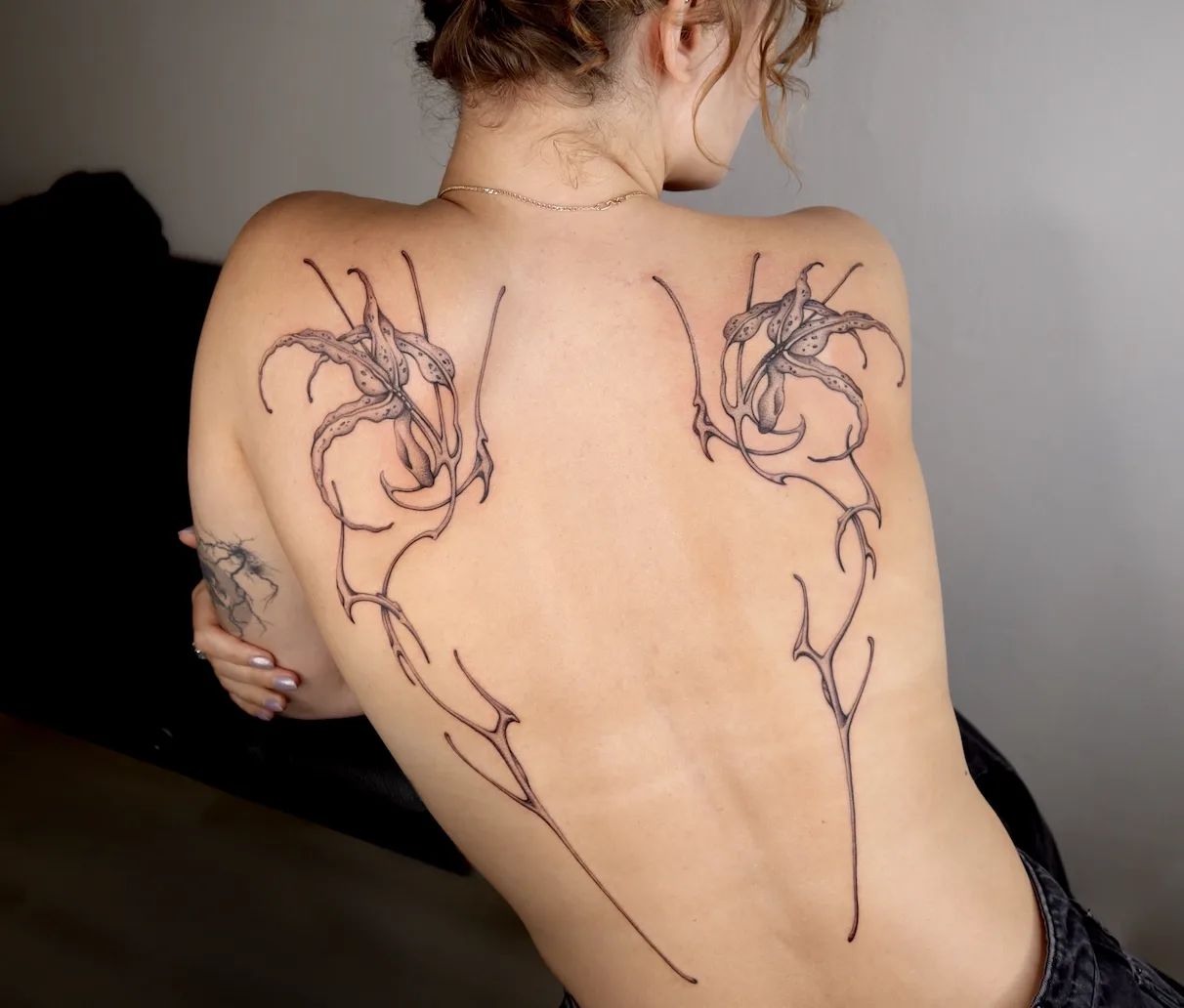
Neo Tribal Tattoos: Where Floral Designs Meet Graphic Forms
Guest article by Sister Serpent from Helsinki: how flowers, insects and chains come together with sharp Neo Tribal forms in a composition that follows the body.
Read more →
Floral tattoos: many accesses to the same motif
A peony can be a large soft grey composition, a clearly drawn bouquet, part of a surreal idea, or a piece in strong color. Four artists, four approaches, and six things that make the difference.
Read more →