Tattoo Blowout: Why Lines Blur and What Can Be Done
A tattoo is freshly done and the lines are clean. A few weeks later, a blue-gray haze appears next to one of the lines that wasn't there before. That is a blowout. Here you'll learn how it happens, how to tell it apart from normal healing and what your options are afterwards.
What is a tattoo blowout?
Tattoo ink is meant to sit in one specific layer of skin, the dermis. If the needle goes too deep, pigment can pass beyond that layer and spread sideways into the tissue below.
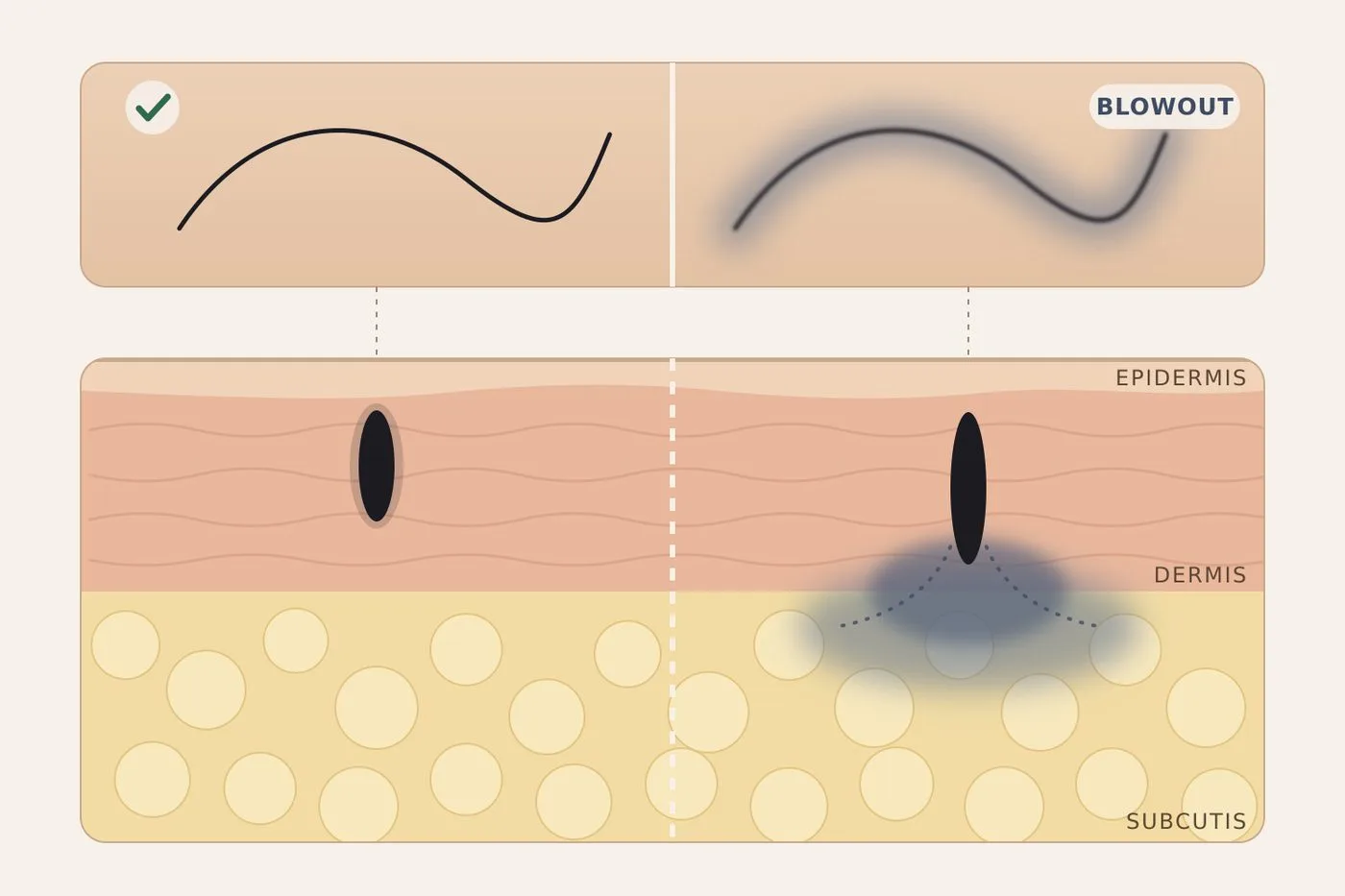
On the left, the ink sits in the dermis and the line stays sharp. On the right, it went too deep and spreads sideways, which shows up as a blue-gray haze on the surface.
The result is a shadow next to the actual line. It often looks blue-gray because the pigment sits deeper and you see it through more tissue.
The original line is often still there, but it looks blurry, a bit like a drawing where the ink has bled into the paper.
How does a blowout happen?
Needle depth is the most important factor. Too much pressure, an unsuitable angle or inconsistent movement can cause pigment to be deposited deeper than intended.
Skin tension matters too. If the skin isn't stretched evenly during tattooing, the needle can enter at different depths even when the artist's hand is steady.
The skin itself plays a role as well. Thin, soft or very mobile skin leaves less room for error. What works easily on one part of the body can be much more demanding on another.
One point is often misunderstood: a blowout happens during tattooing, not during aftercare. You can't cause or prevent one by applying cream or touching the fresh tattoo. Poor aftercare can cause other problems, but it doesn't change how deep the ink sits after the fact.
Which placements are more prone to blowouts?
Blowouts are more common where the skin is thin and there is little tissue underneath. That includes the inner forearm, wrists, fingers, ankles, the top of the foot, the area around the elbow and the ribs. Areas that move a lot or are hard to stretch evenly during tattooing are more demanding as well.
Hands and feet show particularly well how much placement affects the result. Our article on hand and foot tattoos explains why thin skin, constant movement and daily wear come together there.
Why do blowouts stand out more with fine lines?
A blowout is far less noticeable next to a bold black line than next to a very fine one. With a wide, dark line, a small shadow blends into the design. With a hairline, the same shadow can be almost as wide as the line itself and stands out right away.
That's why fine line work needs particularly precise control. More pressure or more ink to make a tattoo look darker right away isn't the better solution. It often makes more sense to work conservatively and decide after healing whether any spots need a touch-up.
Blowout or normal healing?
Not every blurry spot on a fresh tattoo is a blowout. During the first few days, the skin is irritated and swollen, so lines can look softer than they really are. Scabbing, flaking and a slightly cloudy look are also part of normal healing.
A blowout, by contrast, shows up as a shadow next to the line that stays after the swelling has gone down. You can only judge it reliably once the tattoo has fully healed, which takes several weeks. A close-up taken after three days doesn't show the final result yet.
An infection is something else entirely. If an area becomes increasingly red, hot, swollen or painful, it's no longer about how the tattoo looks but about healing. Our article on infected tattoos explains what to watch for.
What can be done about a blowout?
The honest answer first: pigment that sits in a deeper layer of skin can't be brought back up. That's why a blowout doesn't disappear on its own. It may fade a little over the years, just as every tattoo loses some intensity, but it won't heal away. Realistically, there are four options:
Wait and reassess. Right after healing, a blowout often looks more noticeable than it does a few months later. Patience pays off before you decide anything.
Work it into the design. With some designs, the area can be integrated with extra elements, shading or an expanded composition so the blowout no longer reads as a mistake.
Rework or cover it. A bolder design may be able to absorb the affected area. What's possible depends a lot on the existing tattoo.
Laser treatment. Tattoo removal can reduce pigment in deeper layers too, usually over several sessions. It doesn't have to mean full removal: lightening the area is often enough to allow a clean rework afterwards.
Which option makes sense depends on the design, the placement and how pronounced the blowout is. That's hard to judge from a distance, but a sharp photo in daylight already helps a lot.
How can you reduce the risk?
A blowout can never be ruled out completely, but the artist's technique has a big influence. Choosing the right artist is therefore the most important factor: look at healed work, not just fresh photos. Right after the appointment, a blowout often isn't visible yet. Healed tattoos show how cleanly someone really works.
Also check whether the artist regularly works in your style and gives you a clear opinion on size and placement. Our article on choosing a tattoo studio covers what else to look for, and our piece on bad tattoos explains why an unusually cheap offer can end up expensive.
For very delicate designs on thin skin, an honest conversation about expectations is worth it. Sometimes a slightly larger size or a different placement is a better solution than a design that pushes the technical limits of that spot.
Tattoo blowout FAQ
Does a blowout go away on its own?
No. The pigment sits too deep to fade like swelling does. The shadow may get a little lighter over the years, but it stays visible.
Can poor aftercare cause a blowout?
No. A blowout happens while tattooing, when ink is deposited too deep. Poor aftercare can disrupt healing, but it doesn't push ink deeper into the skin.
When can I tell for sure that it's a blowout?
Only once the tattoo has fully healed, which takes several weeks. Before that, swelling and scabbing can make lines look blurrier than they are.
Is a blowout dangerous?
No, a blowout is a cosmetic issue. But if an area becomes increasingly red, hot or painful, that's not a blowout but possibly an infection, and you should have a doctor look at it.
Not sure if it's a blowout?
A blowout is annoying, but it rarely ruins a tattoo. In everyday life it's often less noticeable than in a close-up. What matters is understanding what you're looking at and waiting to decide until the tattoo has healed.
If you're not sure whether you're looking at a blowout or normal healing, send us a daylight photo through our inquiry form. Our artists will tell you honestly what they see and which options are realistic.
Related articles

Color Realism Tattoo in Vienna: When Color Makes the Skin Glow
A realistic color tattoo can look like a photograph on the skin, but it is something else entirely. Learn why a shadow is rarely just darker, why skin is never a white surface, which subjects work, why small color designs are demanding and which tones fade fastest.
Read more →
Tattoo Aging Explained: What Really Happens Under Your Skin?
A tattoo is a drawing that doesn’t sit on your skin, but in your skin. That’s exactly what makes it permanent – and at the same time it’s the reason a tattoo changes over the …
Read more →
How to Prepare Your Skin Before a Tattoo: What Actually Helps
You don't need an elaborate routine to get your skin ready for a tattoo. What actually helps: regular moisturizing in the days before, as little sun as possible, no fresh irritation, and simply clean, dry skin on the day itself.
Read more →